


- Article
In the field of power and process steam generation, fluidized bed (FB) technology has been among the key combustion technologies for decades. While FB boilers were first developed for woody biomass combustion, current market trends demand a wider variety of fuel qualities such as sorted wastes and residual biomass. Along such ever-growing fuel flexibility, combustion systems also need to meet operability with ever-wider load ranges and ever-stricter environmental regulations, often challenging to achieve with conventional solutions.
Sumitomo SHI FW (SFW) continues to improve its combustion solutions to meet the increasing demands with innovative approaches. A recent innovation concerns the introduction of a secondary air nozzle design that produces constant air velocity at all operating conditions. The same solution can be used for any gas to be introduced into a reactor, not only air. The new design can be applied, among others, to fluidized bed systems, including bubbling fluidized bed boilers.
Challenges posed by conventional secondary air systems
When designing a reactor, e.g. a boiler, for a wide range of fuel types and characteristics, each fuel may require a substantially different split of combustion air between Primary, Secondary, and Tertiary feeds. This split of air flows also needs adjustments depending on fuel mixture and boiler operating conditions, e.g. load. In conventional, circular, secondary air nozzles, varying air flow rates mean also changing air penetration into the reactor cross-section, which may partially compromise combustion and emission performance in some operating conditions. The novel design by SFW is intended to overcome this limitation and can be applied also for the injection of gases other than air.
SFW’s novel design for nozzles for constant velocity
The implementation of the constant velocity nozzle design aims at maintaining constant air penetration into reactors under various operating conditions. A typical application is the penetration of staged air into a fluidized bed combustor, as described below. SFW’s nozzle design is depicted in the below visualization.
Image
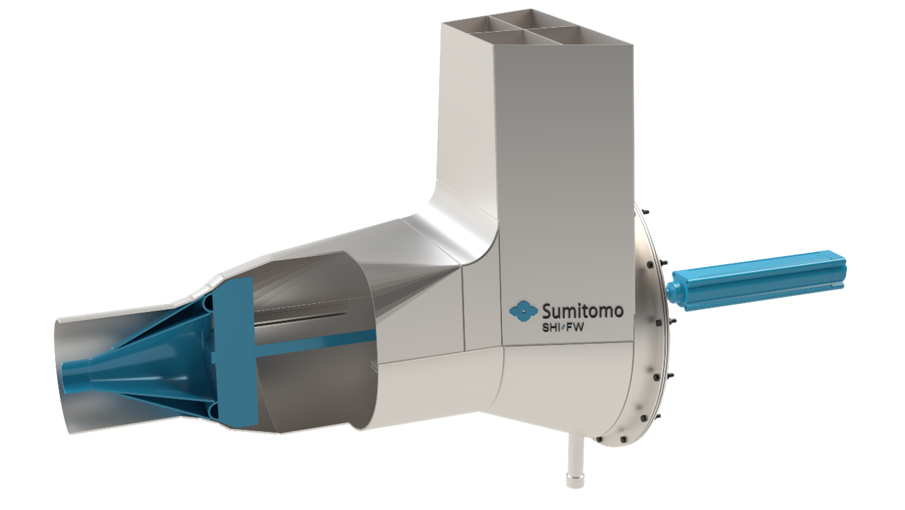
The nozzle receives air from an air distributing duct into the nozzle’s inlet chamber. Air enters into the boiler furnace via two parallel pathways; a fixed-diameter inner nozzle located inside an adjustable conical valve, and an outer annulus formed by the gap available between the adjustable valve and the nozzle body’s conical part.
The main functional feature and principle is the free and stepless adjustability done with an actuator, whose operation can be connected to the plant DCS with optimized operation patterns. Individual automated control for each nozzle is also possible.
Optionally, to even out the air flow introduced into the furnace, the air distributing duct and/or the inlet can be divided into several compartments by one or more partition walls arranged therein. In addition, an insert can be fixed inside the inner nozzle. The insert preferably has a streamlined shape, and its size can be selected based on operating conditions. This way, the controllability is further enhanced, and adjustment of the nozzle inner dimensions is simplified.
What are the key benefits of SFW’s constant velocity nozzle?
The design of SFW’s Constant Velocity Nozzle can improve process performance in multiple ways.
The interaction of the flow jets from the inner nozzle and outer gap creates a co-current, effective air jet which can maintain a nearly constant penetration into the combustion chamber.
From design perspective, the design concept allows for standardized sizing of all the nozzles regardless of fuel or operating demands as each nozzle can be set individually to its required flow rate. This enables to tune any desirable air/gas distribution pattern with a single component of standard dimensions, repeatable across different reactors (e.g. boilers) and projects.
This innovative design reflects SFW’s continuous development to improve its combustion solutions.